

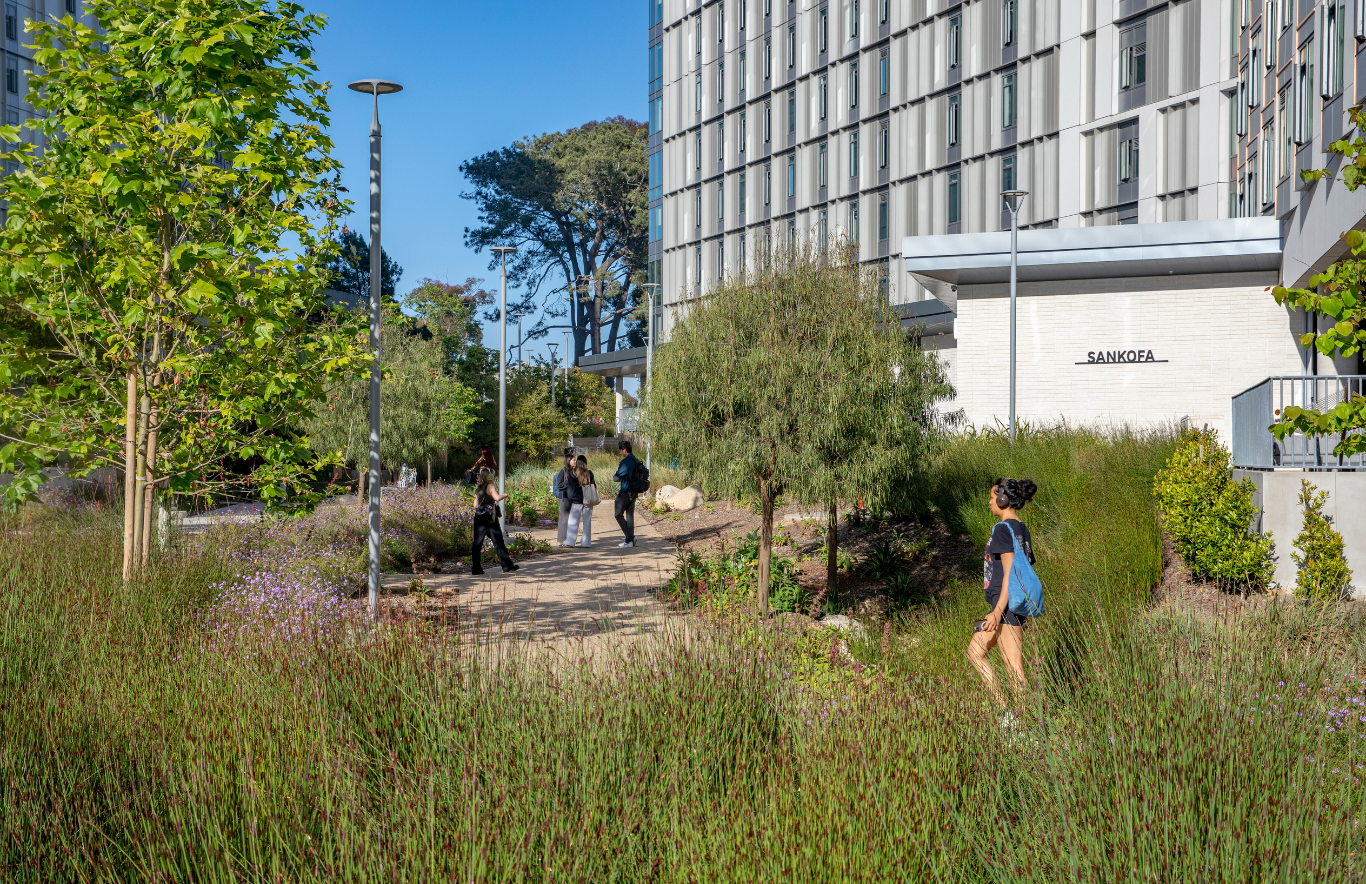
Students walking along an outdoor path at University of California San Diego Theatre District Living and Learning Neighborhood. | Photo Credit: SWA Group – David Lloyd
By Lindsey Coulter
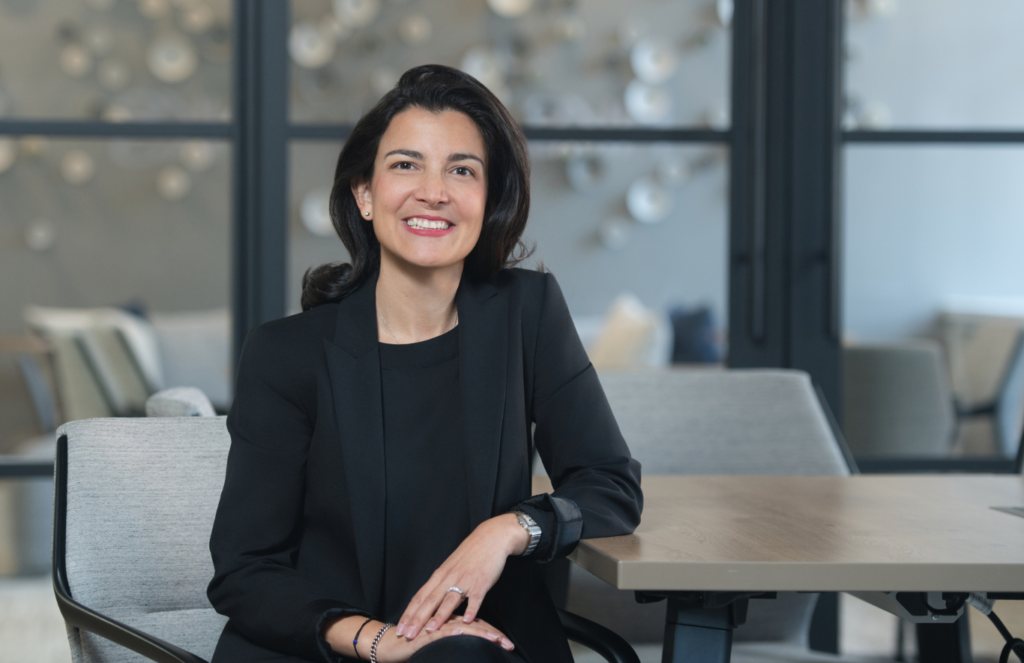
Earlier this year, global design firm HKS launched a new Regenerative Design team, reinforcing its commitment to systems thinking to create net positive outcomes for people, ecosystems and the built environment. The initiative shifts focus from minimizing harm to actively restoring ecological and community systems.
Led by Director Yasemin Kologlu, the team integrates expertise in regenerative strategies, nature-based solutions and high-performance design. Members collaborate across disciplines to address climate, energy, water, materials, and social equity through tailored approaches rather than standardized checklists.
“Embracing regenerative design as a change agent at scale as a global firm is not just a next step: it is an imperative in driving positive change,” Kologlu said. “Regenerative design, for us, is a holistic approach to design that actively seeks to create net positive impact for people and planet.”
This fundamentally requires a different mindset. The group emphasizes deep understanding of local contexts to uncover opportunities for long term impact. Working across scales, it seeks to connect natural and built systems, strengthen communities and enhance resilience. The multidisciplinary team includes experienced designers and specialists in sustainability, computation, and architecture, supporting HKS’s goal of creating environments that give more than they take. Their work also promotes wellness, biodiversity, and circular resource use across projects globally.
Kologlu says that the firm’s work is inspired by curiosity, driven by research and technology, and informed by a deep understanding of human and environmental needs.
“We love asking the ‘What if?’ questions that often challenge status quo and preconceived ideas, free up our mind, and get us to look at our work and our partnerships differently,” Kologlu said. “It is as much a culture, mindset evolution as a product evolution.”
Kologlu spoke with Green Building News about measuring success, how the approach differs from traditional sustainability consulting models, and what the team hopes to accomplish in its first year.
GBN: HKS frames regenerative design as moving beyond harm reduction to net-positive impact—how are you translating that ambition into measurable project KPIs?
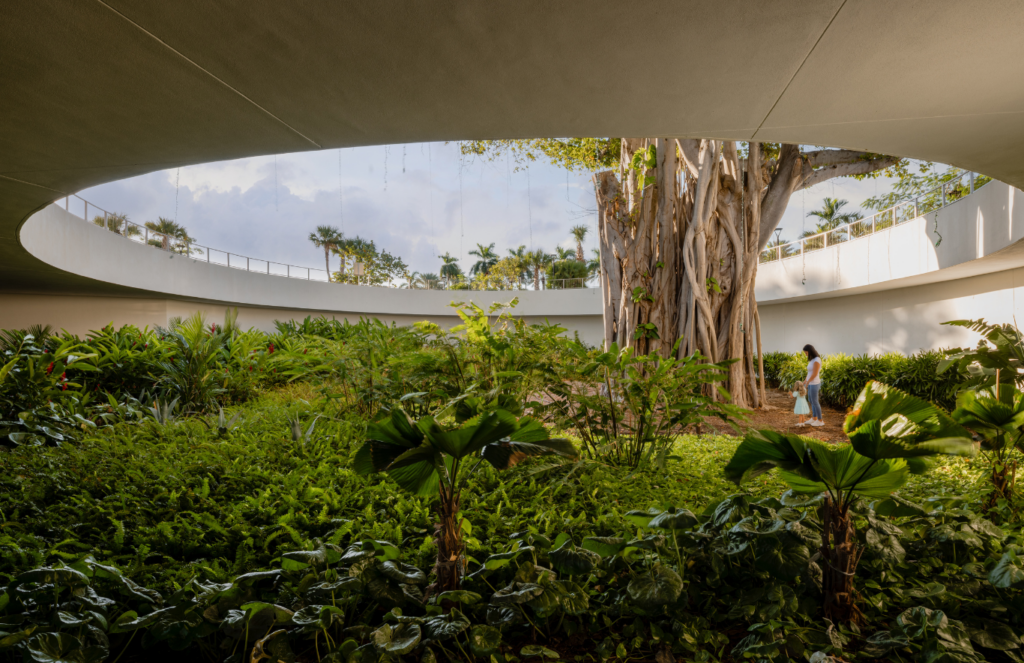
Kologlu: We define regenerative design as a systems-thinking approach to design that actively seeks to create net positive impact for people, planet and ecosystems. It is about finding complimentary synergy between natural and human systems. This is less about isolating energy vs. water vs. carbon into individual KPIs as the starting point and more about creating an ecosystem.
For me personally, it is about finding opportunities that are specific to 3 C’s: Community, Context and Climate. When you anchor in these C’s, they give us so many clues as to what our work can do to purposefully restore ecological vitality, create habitat, generate clean energy, balance water cycles, capture carbon, support material health and circularity, expand equity and access, and advocate for future generations. These transformative outcomes don’t happen by accident. They grow from a shared collective vision, a collaborative mindset, and deep sustained partnerships among designers, clients and communities who are inspired to reimagine what is possible together.
This is also about unlocking synergies between natural and built systems, starting with climate-responsive Passive Design and understanding how sun, wind, water, soil, and weather shape our design, its site and its microclimate. It’s understanding how people interact with each other and with the built environment in a specific culture and context. And then it’s expanding beyond the traditional boundaries and assumed timelines to explore how we create positive impact overall. It is almost going back to design basics first that is already captured in traditional and indigenous place specific knowledge and practices that have been used by communities across the world for millennia and then support that with our advance scientific knowledge and tech.
GBN: What does the Regenerative Design team’s engagement look like in practice across project phases, and how does it differ from traditional sustainability consulting?
Kologlu: Regenerative design is a full design mindset that empowers creators and gives them agency to assess, challenge, create environments and systems that aim to improve people’s lives over time. In each project, every team member is a creator in their own way, from the project’s beginning to its completion. The creators also include our clients, the communities we design for and with and the many others we collaborate deeply with over the course of our project’s lifespan. This is a shift in practice, where regenerative design approach becomes an underlay for design; everything is based and built on it. In contrast to how much of our industry is sadly treating sustainability as an overlay or add on, a sidetrack that one deploys with checklists that are increasingly complex and administratively heavy.
GBN: How is the regenerative design approach being embedded into multidisciplinary coordination with engineers, contractors and owners to ensure outcomes persist through value engineering and construction?
Kologlu: Given regenerative design is a mindset and systems thinking to create net positive impact, it requires radical collaboration, exploration and curious mindsets by all engaged in our work. It requires us to ask those “what if” questions from the start and continually challenge each other to create opportunities at every stage and actually capitalize on these opportunities together. This approach grows from a shared collective vision, a collaborative mindset, and deep sustained partnerships among designers, clients, and communities who are inspired to reimagine what is possible together. I often talk about how 2+2 can equal 5 through deep meaningful co-creation, and I say that because I have done and seen that many times in practice. There is nothing like creating something better together than either party could do it alone; the joy of that is priceless and magical.