

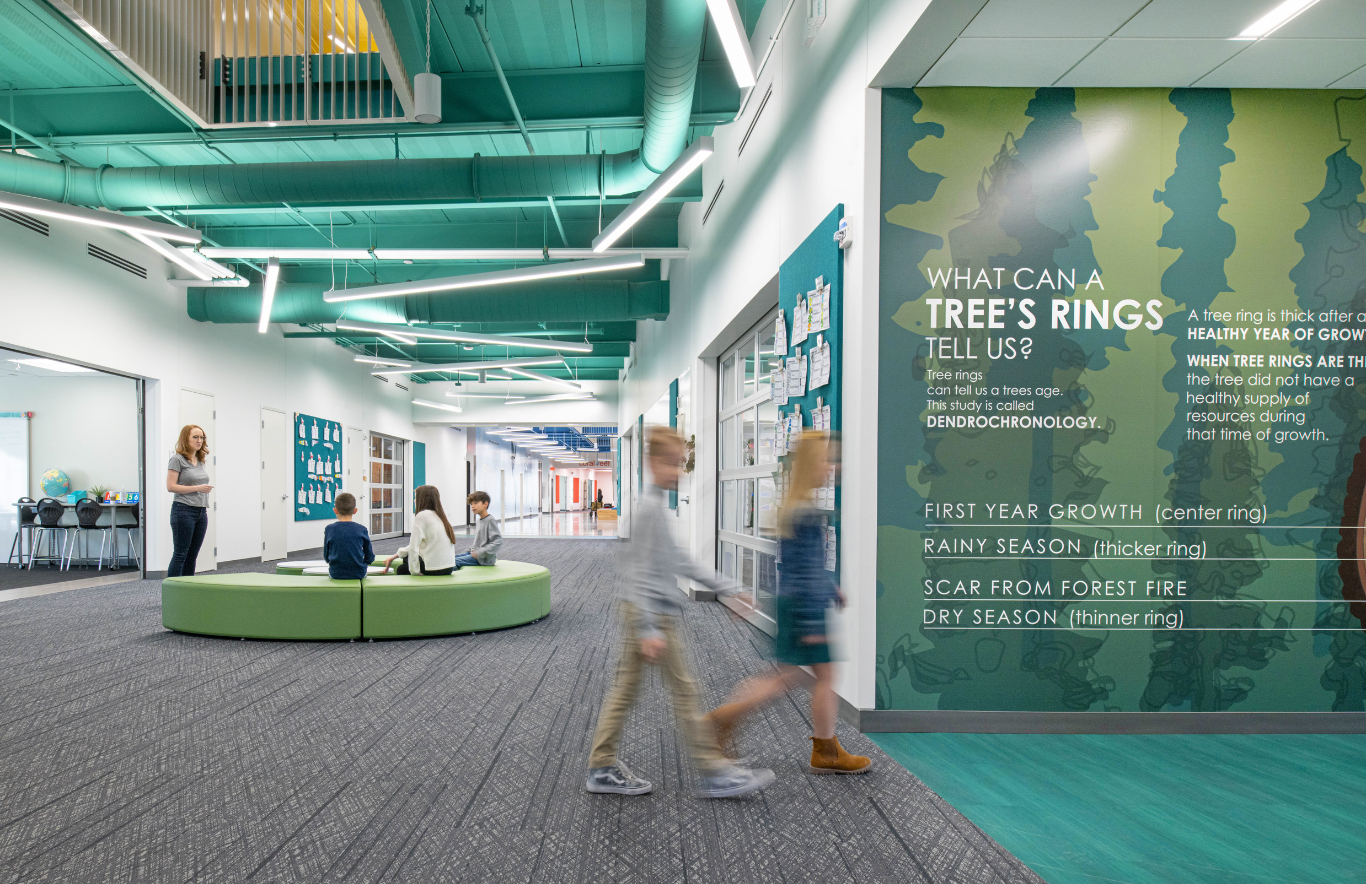
Shawnee Mission School District’s John Diemer Elementary School pursued LEED certification. | Photo Credit (all): Matt Kocourek
By Julianne Laue & Sara Greenwood
The conversation around sustainable building in education has shifted dramatically. No longer a niche consideration for progressive districts, LEED certification has become a strategic tool for school systems seeking to enhance student outcomes, control long-term costs and demonstrate community leadership. As municipalities confront aging infrastructure and competitive grant funding environments, understanding how to effectively implement green building standards has become central to facilities planning.
Understanding the Certification Landscape
The distinction between LEED and WELL certifications represent a fundamental evolution in how we conceptualize building performance. LEED focuses primarily on building performance — energy efficiency, water conservation and environmental impact — while WELL certification addresses the health and wellness of building occupants through organizational best practices, human resources policies and facility maintenance protocols.
“LEED is about the building’s performance, and WELL is about the people inside,” explains Sara Greenwood, LEED Fellow, WELL Faculty and Green Globes Professional. Greenwood is also the owner and CEO of Greenwood Consulting Group, and has more than 20 years of sustainability consulting experience.
This differentiation is crucial for district leaders navigating certification options. While LEED ensures third-party validation of sustainability metrics, WELL requires documentation of emergency preparedness plans, cybersecurity measures, nutrition standards, as well as verified testing of air quality, water quality, lighting and acoustics.
As JE Dunn Construction’s recently appointed environmental and sustainability director, Julianne Laue brings nearly three decades of experience navigating these distinctions across complex construction projects. “The key is understanding that sustainable design and construction require collaboration,” Laue emphasizes. “We work with design teams to build consensus with project stakeholders and leverage partnerships with trade partners to achieve goals and drive innovation. It’s about balancing constructability, lifecycle cost and energy use at every phase.”
Measurable Impact on Health and Performance
The health benefits of LEED-certified schools extend far beyond environmental stewardship. Research demonstrates that student performance improves significantly in classrooms with adequate daylighting, clean air quality and biophilic design elements. The statistics are compelling: according to the Green Education Foundation, more than 20% of U.S. public schools report unsatisfactory indoor air quality and asthma remains the leading cause of disease-related absenteeism in American public schools.
Greenwood emphasizes that “by improving indoor air quality, green schools can improve the health of students, faculty and staff, potentially decreasing sick days.” The impact is particularly pronounced for younger students, whose developing respiratory systems are more vulnerable to harmful chemicals and poor ventilation. LEED-certified schools address this through strict material selection protocols and enhanced ventilation systems.
Acoustics represent another critical factor. Unlike other building types where acoustics are optional, LEED mandates acoustic performance standards for educational facilities. Poor acoustics — such as noisy HVAC systems — can significantly hinder learning, particularly for English language learners who struggle to hear clearly, compromising equitable engagement.
Financial Returns That Strengthen District Budgets
The financial case for LEED certification challenges common misconceptions about cost premiums. According to GBRI, operating costs for energy and water in green schools can be reduced by 20% to 40%, directing more funding toward teacher salaries, textbooks and technology. The average green school reduces water usage by 32%, creating both direct savings and substantial societal benefits through reduced stormwater runoff and wastewater treatment demands.
According to recent data from the U.S. Green Building Council, more than 5,000 schools are now LEED-certified, impacting the lives of eight million students. These schools save an average of $100,000 per year on direct operating costs — equivalent to hiring two new teachers, purchasing 200 computers or buying 5,000 textbooks.
The financial benefits extend beyond operational savings. A recent report from the American Institute of Architects documents that the financial benefits of greening schools reach approximately $70 per square foot — more than 20 times higher than the initial cost of implementing green features. This represents a fiscally superior design choice that pays dividends for decades.
Case Study: Shawnee Mission School District
The Shawnee Mission School District exemplifies successful large-scale implementation. After passing their 2021 bond, district leaders made an early commitment to pursue LEED certification across all new construction projects. JE Dunn built three new elementary schools as part of this initiative: John Diemer Elementary (opened August 2023), Rushton Elementary (opened August 2024), and Tomahawk Elementary (scheduled to open August 2025).
What distinguished this project was the comprehensive stakeholder engagement.
“There was tremendous involvement from the community, district leaders, the design team and the JE Dunn project team throughout the entire process,” Greenwood notes.
Students themselves took leadership roles, creating programs focused on pursuing certification and holding student-led forums that pushed the district to maintain its commitment. Laue added that the JE Dunn project team “handled every challenge with a can-do attitude and collaborated seamlessly. Any issue that arose during construction was presented with viable solutions, resulting in beautiful and successful projects for the students and patrons of Shawnee Mission School District.”
The district began with a goal-setting strategy meeting that produced a living document gathering all relevant owner project requirements. This approach created consistency across multiple schools, streamlining design construction andmaintenance processes, while ensuring alignment of energy, water, waste, health and certification goals.
Read more about implementation, dispelling the cost myth and moving beyond certification in the latest issue of School Construction News.
Julianne Laue is the Environmental and Sustainability Director at JE Dunn Construction, where she leads the company’s sustainability initiatives and strategy.
Sara Greenwood, LEED Fellow, WELL Faculty and Green Globes Professional, is the Owner and CEO of sustainability consulting firm Greenwood Consulting Group.