

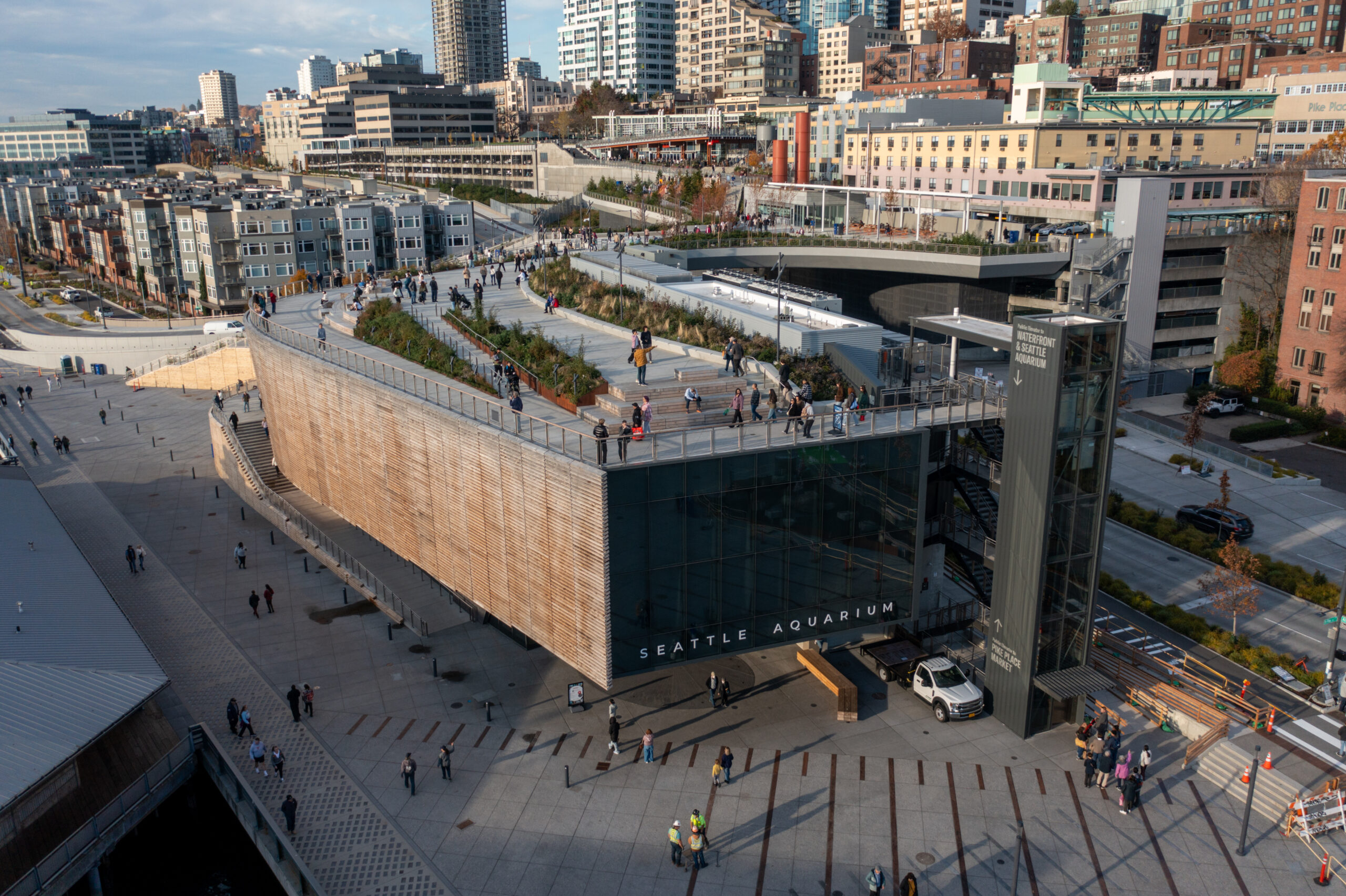
Sustainability is one of the core institutional values of the Seattle Aquarium. The Ocean Pavilion amplifies the Seattle Aquarium’s mission through sustainable solutions like a planted roof surface to reduce pollution from stormwater. The installation of energy efficient LED luminaires supports the aquarium’s commitment to sustainability.| Photo Credit: Courtesy of Seattle Aquarium
By Matthew Szymanski
The Seattle Aquarium Ocean Pavilion (SAOP) embodies interconnectivity and sustainability, integrating with the urban waterfront and highlighting the connection between people and marine life at home and around the world.
The 50,000-square-foot building features living habitats and ecological experiences, moving beyond traditional aquarium models to tell an unforgettable story about Earth’s one ocean through state-of-the-art digital storytelling. The project honors its location on the traditional lands of the Coast Salish peoples, incorporating their input into the design and cultural framework for the building, landscape, exhibits and public art.
The Pavilion, designed by LMN Architects along with Thinc Design, which designed the exhibit spaces, includes two large, public-facing habitats. The first is The Reef, a nearly 500,000-gallon, multi-story area designed to mirror an Indo-Pacific coral reef. The second habitat consists of two smaller habitats: the Archipelago, an Indonesian mangrove forest that’s surrounded by a pool of sea stars fish and rays, as well as live plants, and another habitat that includes a variety of fish species and live coral.
Unique Construction
The large habitats have essentially no straight edges and The Reef consists of 680 cubic yards of concrete and 355 tons of rebar — four times the rebar used in a typical core — comprise the 2-foot-thick walls with six layers of reinforcement. The Aquarium is in the heart of downtown Seattle’s waterfront, which has been undergoing a multi-year redevelopment. Site constraints, coupled with a small footprint on a fill site in a seismic zone, required careful logistics planning. The site left little space for staging, and the geometry of the primary habitats meant that formwork coordination and prefabrication efforts would need to account for the numerous life support systems and embedments prior to site delivery.
The Turner Construction team worked from a contractual 3D model provided by LMN Architects that represented the geometry of the primary habitats. This was the basis for Turner’s self-perform concrete detailing efforts and combined all the formwork, rebar, embedments, acrylic viewing windows and mechanical systems into one model that was used to generate shop drawings and digitally fabricated formwork elements.
Environmental Stewardship

The Aquarium’s vision is to produce more environmental benefits than harm to help ensure a climate-resilient, sustainable future for all; in other words, to become a regenerative aquarium. This commitment is reflected throughout the Ocean Pavilion, which is certified LEED Gold and is targeting Zero Carbon Certification. The facility operates fossil fuel-free, recirculating nearly all of the salt water in its habitats — saving water and energy. Water-to-water heat exchangers recapture heat from tank water being discharged and use it to heat the incoming makeup seawater from Puget Sound. Using water from Puget Sound reduces the amount of potable water used for exhibits.
The heating and cooling systems use 91% less energy than traditional systems, and the architectural and design teams carefully chose materials such as Alaskan yellow cedar exterior panels on the building’s west face, which are Forest Stewardship Council-certified and come from an Indigenous-led company.
To achieve Zero Carbon Certification, which requires the Aquarium to offset 100 percent of its operational energy use with new renewable energy, the organization is developing a power purchase agreement that will add solar renewable energy capacity to Seattle’s electric grid.
Carpet made of recycled fishing nets and recycled-paper Richlite paneling reflect the commitment to environmental stewardship, while the dichroic acrylic accents, exposed mechanicals and working with Indigenous consultants speaks to transparency, inclusion and interconnectedness.
Additionally, the pavilion uses concrete mixes designed to reduce its carbon footprint, including Portland-limestone cement. Panels made from recycled materials are also used for walls and ceilings.
SOAP is the first aquarium building in the world to pursue Living Future Institute (ILF) certification.
Corrosive Environments and Lighting
Lighting is an important component throughout SAOP to prioritize the animals’ needs while also enhancing the habitats and exhibits. For example, the team had to make sure there were enough lighting requirements for all of the plants, including grow lights.
“The animals are very sensitive to light, so the entire facility includes a lighting control system based on the animals’ circadian rhythm,” said Hanna Kato, Project Architect, LMN. “This means the front-of-house light output slowly increases over an approximately 90-minute timeframe. The duration that they stay at this level, and when the light output gradually decreases, is all specifically planned with the Seattle Aquarium Ocean Pavilion aquarists.”
Equally critical is the back-of-house (BOH) infrastructure. BOH facilities in aquarium life support systems operate 24/7/365 to maintain water quality and keep the animals healthy. These corrosive settings need chemical-resistant luminaires, certified for wet locations, to ensure the fixtures don’t fail, while performing at optimum light output. High IP-ratings prevent the ingress of dust and water into the fixtures, reducing maintenance costs and time. These factors are crucial for ensuring worker safety, optimizing productivity and maintaining efficient operations.
Corridor Lighting
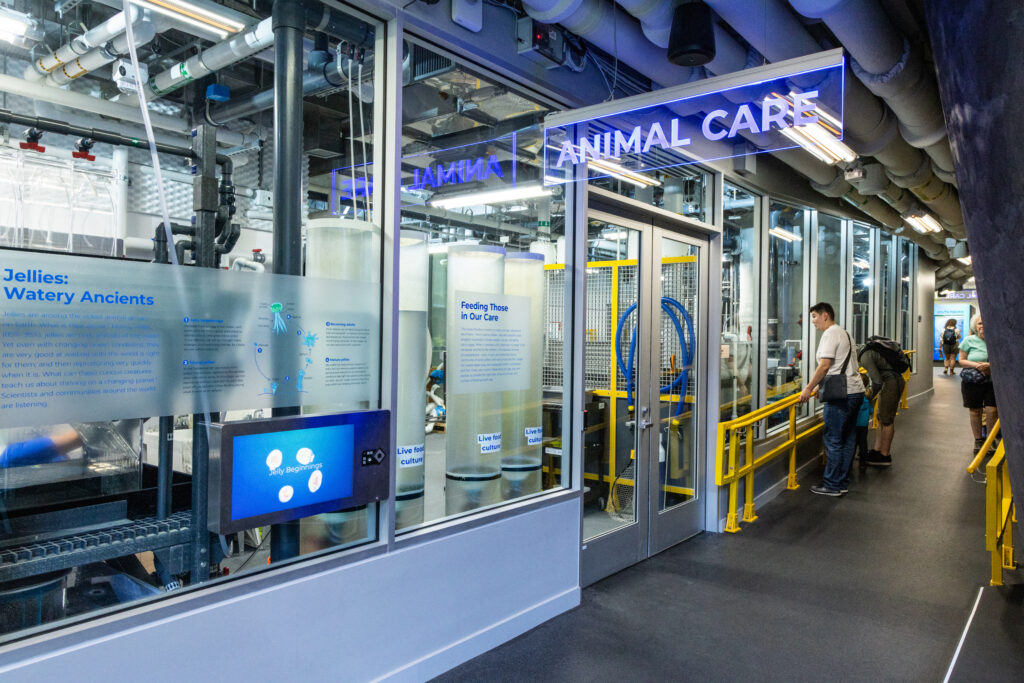
When specifying lighting for SAOP, project designers considered the duties of employees who work with the animals as well as those responsible for the building systems and guest areas.
“The aquarium and the exhibit designer collaboratively decided to incorporate behind-the-scenes (areas) as a component for the guest experience,” said Susan Bullerdick, the aquarium’s Senior Director of Capital Projects. “As such, the lighting ensures guests can safely navigate hallways and also allows them to clearly observe intricate details of the animal habitats and equipment.”
Complementing the other sustainable infrastructure features are LED luminaires installed in the BOH corridors. The lighting system not only needed to be energy efficient but, more importantly, withstand the corrosive environment. Lighting industry veteran Ben Kuritz, Director of Architectural & Specification Sales at PLSWA, recommended Kenall Manufacturing’s SenScape 18” diameter ceiling-mounted luminaires.
“Because Kenall’s luminaires are known for their corrosion-resistant, high-abuse properties, I knew SenScape – with its marine-grade die-cast aluminum construction – would be the ideal product for the Aquarium’s BOH corridors,” said Kuritz. “Additionally, the IP65 rating is suitable for this wet location.”
SenScape’s light output ranges from 3,086 lumens to 12,943 lumens, ensuring the corridors have bright, white illumination and are evenly lit.
“Knowing that Kenall’s SenScape fixtures withstand a 1,000-hour salt spray test gives me confidence that these luminaires installed in the corridors can meet SAOP’s challenging environment,” said Phillips-Kress.
Matt Szymanski is Western regional sales manager for Kenall and may be reached at [email protected].